Guide
Home EV charging station: how to choose
Your own charging station is the most convenient and cheapest way to charge an electric car: in the morning it is always waiting fully charged.
5 min read · 8 sections
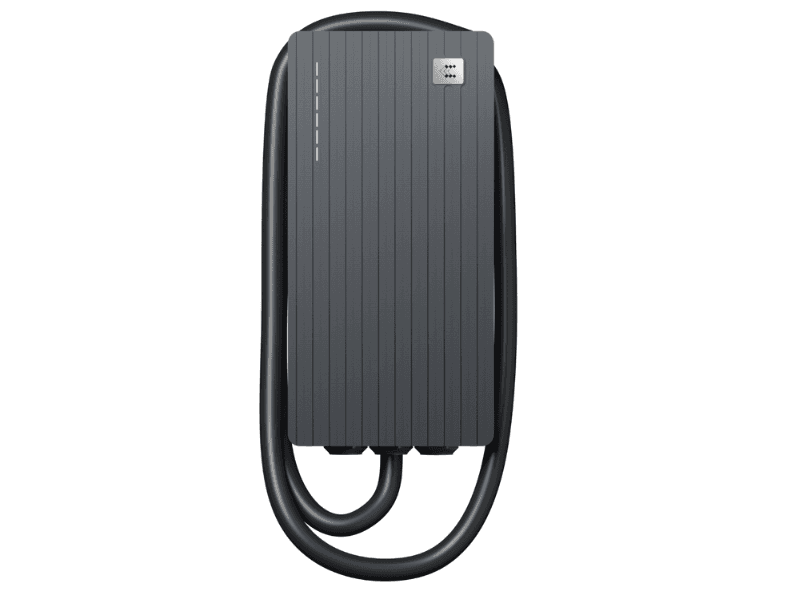
Your own charging station is the most convenient and cheapest way to charge an electric car: in the morning it is always waiting fully charged. In this guide we explain how 11 kW and 22 kW stations differ, when you need load balancing and what installation costs – with links to Teltonika, SolaX and VOOL stations.
AC charging at home: why public chargers are not enough
A home station supplies alternating current (AC), and the car's on-board charger converts it to DC, so charging speed is limited by the car as well. Unlike an ordinary socket, it communicates with the car and controls the current safely.
Public chargers are fine for trips, but inconvenient day to day: you have to drive there, wait and pay the operator's rate. At home the car sits all night, so 11 kW is enough to charge it on cheaper night-time or solar electricity.
11 kW or 22 kW: the car's on-board charger and a three-phase supply
An 11 kW station draws 16 A from each phase (3 × 16 A), a 22 kW station 32 A per phase (3 × 32 A). Both connect to three phases, but a 22 kW station needs a three-phase supply with enough capacity – that already counts as extended installation.
The on-board charger of most electric cars accepts no more than 11 kW, and only some models accept 22 kW, so first check your car's AC charging power.
Teltonika TeltoCharge, Teltonika EVC2 and SolaX X3-HAC G2 come in both power ratings, while VOOL comes in 22 kW only.
Type 2 socket or integrated cable
A station with a Type 2 socket is more versatile: you plug in a cable of the length you need and take it with you on trips. Socket versions are usually cheaper – the most affordable station costs from €488.
An integrated cable (5 m on Teltonika, 6.5 m on SolaX and VOOL) is more convenient day to day: plug in and charging starts. It is worth fitting a VOOL cable hook nearby so the cable does not lie on the ground.
Dynamic load balancing and smart meters
Dynamic load balancing: the station measures the total household load and automatically reduces the charging current when the cooker or heat pump switches on, so the main circuit breaker does not trip and you do not need a bigger supply.
Balancing requires a smart meter at the supply point: the three-phase Eastron SDM72D, the wireless Shelly Pro 3EM or the VOOL LMC Basic intended for VOOL stations – all in the accessories category. We advise free of charge on the right one for your station.
The SolaX X3-HAC G2 already includes a current transformer (CT); balancing is part of extended installation.
Safety: circuit breaker, RCD, IP rating
Every station is connected through its own circuit breaker and residual-current device (RCD). For an AC station a Type A RCD with 6 mA DC leakage detection (often built into the station) or a Type B RCD is suitable – a certified electrician assesses this.
Outdoors choose an enclosure rated at least IP54; the specific model's IP rating is given in the manufacturer's specification. The cable must not cross the driveway.
App control, OCPP and RFID
The app lets you schedule charging at the cheaper night tariff, limit the current and view the history – during installation EVZONA electricians configure it and show you how to use it.
OCPP is an open protocol for connecting the station to a management platform: not essential at home, but useful in apartment buildings and businesses – for business we offer an OCPP management platform. An RFID card or the app keeps unauthorised users out.
Installation process and price
Standard installation – €449 (up to 11 kW, distribution board within 5 m): cable routing, a circuit breaker and an RCD, mounting, commissioning and app configuration. The cheapest station with installation is from €937. Certified electricians install anywhere in Lithuania, with a 5-year workmanship warranty.
Extended installation (a three-phase 22 kW connection, dynamic load balancing, a distribution board upgrade) is quoted individually once we have assessed the site and chosen the solution. In apartment buildings we help obtain the owners' association's approval and install a station with individual metering – see installation services.
State support and a selection checklist
As of September 2026 there are no open calls for private stations – the household programme closed in June 2026. A Social Climate Fund call for charging points up to 22 kW is planned for Q1 2027, but only for vulnerable households and micro-enterprises that purchased an EV under the fund's measures; the conditions are preliminary – keep an eye on the support page.
1) your car's AC power and your supply; 2) 11 kW for most, 22 kW if the car and the supply allow it; 3) socket or cable; 4) weak supply or a solar plant – balancing; 5) outdoors – IP rating; 6) app, RFID, OCPP for business.
We recommend: Teltonika TeltoCharge – 11/22 kW, socket or 5 m cable; Teltonika EVC2 – 11/22 kW, socket or 5 m cable; SolaX X3-HAC G2 – 11/22 kW, 6.5 m cable, CT included; VOOL 22 kW – 6.5 m cable, matte black. Contact us – we advise free of charge.