Guide
Home energy storage: how to choose the capacity and the system
An energy storage system lets you use solar electricity stored during the day, or cheaper night-tariff energy, exactly when you need it most.
7 min read · 8 sections
An energy storage system lets you use solar electricity stored during the day, or cheaper night-tariff energy, exactly when you need it most. This guide explains how much capacity a home needs, how high-voltage (HV) and low-voltage (LV) systems differ and why a hybrid inverter is essential – with examples from our energy storage range.
Why you need an energy storage system
The most common reason is surplus solar generation: during the day the modules produce more than the home consumes, and the battery releases this surplus in the evening and at night.
The second reason is the night tariff: the battery can be charged with cheaper night-time electricity and discharged during the daytime peak. The third is backup power: a hybrid inverter with an EPS function keeps powering selected appliances from the battery when the grid goes down.
How to choose the capacity
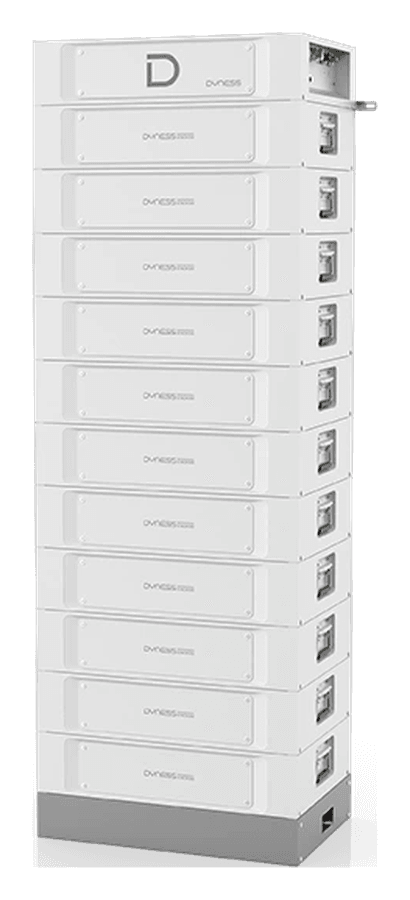
Choose capacity based on your evening and night-time consumption, not on the size of the solar array. An average home usually needs about 11 kWh – for example the three-module SolaX T-BAT HV S3.6 (11 kWh) or the three-module Dyness Tower Pro (11.52 kWh).
For a home with a heat pump we recommend about 15 kWh – the four-module SolaX T-BAT HV S3.6 (14.7 kWh) or Dyness Tower Pro (15.36 kWh). If an electric car is charged at home as well, go for 18 kWh or more – an 11 kW charging station draws up to 11 kWh per hour.
At a 90–95 % depth of discharge (DOD), an 11 kWh battery actually delivers about 10 kWh of usable energy.
LiFePO4 technology, cycle life and the 10-year warranty
All our storage systems use lithium iron phosphate (LiFePO4) cells – this chemistry is thermally more stable than other lithium-ion technologies, and the integrated BMS monitors the voltage, current and temperature of every cell.
The SolaX T-BAT HV S3.6 cells last more than 6,000 cycles, the Dyness Tower Pro, STACK100 and PowerBrick Plus more than 8,000. All SolaX, Dyness and Solplanet storage systems come with a 10-year manufacturer's warranty, and EVZONA installation work is covered by an additional 5-year warranty.
High-voltage (HV) and low-voltage (LV) systems, modular expansion
In high-voltage (HV) systems the modules are connected in series, so the voltage reaches hundreds of volts; for the same power, a higher voltage means a lower current and lower losses. That is why most of our systems – SolaX T-BAT, Dyness Tower Pro, Dyness STACK100 and Solplanet Ai-HB G2 Pro – are high-voltage.
Low-voltage (LV) systems operate at roughly 48–51.2 V – for example the Dyness PowerBrick Plus 16.08 kWh, connected to a low-voltage hybrid inverter such as the Solis S6-EH3P LV or the Deye SUN SG05LP3-EU.
All the systems are modular: the SolaX T-BAT HV S3.6 expands in 3.68 kWh modules up to 47.9 kWh, the Dyness Tower Pro up to 23.04 kWh, and the Dyness STACK100 in 5.12 kWh modules up to 76.8 kWh.
A hybrid inverter is a must: compatibility
A battery is charged and discharged by a hybrid inverter, and an ordinary grid inverter cannot manage batteries. If you already have a solar plant with a grid inverter, we first assess your inverter – model, phases and compatibility – and, if it cannot manage a battery, swap it for a hybrid from our inverter range paired with the battery. The solution is described on Battery for an existing solar plant.
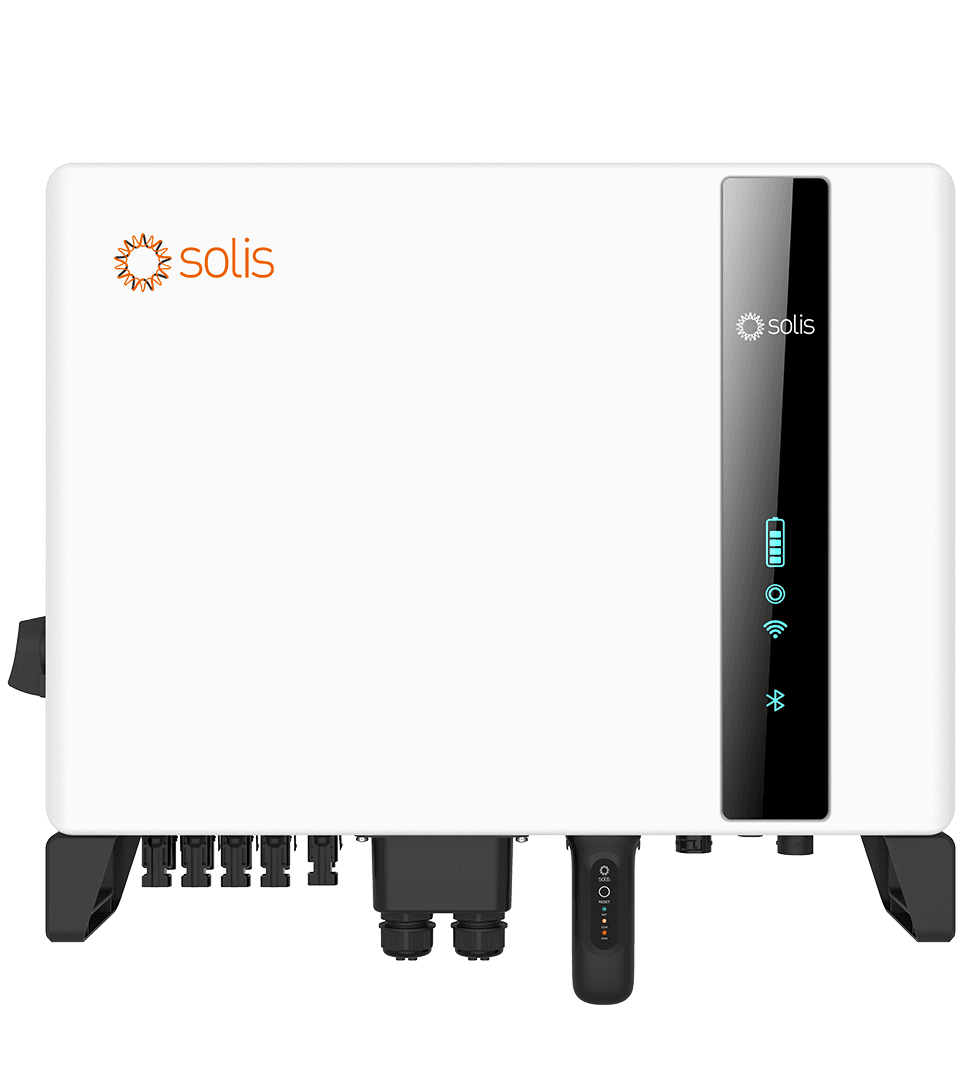
The inverter must be on the battery manufacturer's compatibility list: the SolaX T-BAT works with the SolaX X1 / X3-Hybrid G4, and the Dyness Tower Pro with Solis, Deye, Solplanet, GoodWe, Growatt and the other inverters on its list, for example the high-voltage Solis S6-EH3P HV.
The Solplanet Ai-HB G2 Pro is the manufacturer's high-voltage system for Solplanet hybrid inverters such as the Solplanet ASW kH-T3 – we confirm compatibility with the specific inverter model during the consultation. The Deye SUN SG05LP3-EU we offer is a low-voltage inverter, so it suits the PowerBrick Plus, not the Tower Pro.
Where it is installed and what it costs
A battery is usually floor-mounted next to the inverter and the distribution board to keep cable runs short. The protection rating dictates the location: the SolaX T-BAT HV S3.6 (IP65, heating down to -30 °C) is fine even in an unheated garage, the Dyness Tower Pro (IP55) needs a dry spot sheltered from precipitation, and the Dyness STACK100 (IP20) is for indoor rooms only.
Installation is quoted individually: we survey the site, connect the battery to the inverter and the distribution board, fit the protective automation and commission it, and we send an exact installation quote once we have assessed the site conditions and chosen the most suitable solution. The equipment starts at €2,116 for the base configuration.
State support for storage systems
New support calls are expected in autumn 2026: €170 per 1 kWh of capacity for storage systems and €3,500 for a solar-plus-storage package. The storage call is aimed at households with a solar plant on the same supply point, the package call at those installing both together; the application is submitted via APVIS after the equipment has been installed, and previously no more than 15 kWh of capacity was supported.
New LiFePO4 or lithium-ion storage systems with a CE mark are eligible – all our storage systems are LiFePO4. The funds of the previous call were reserved in less than two days, so we help you prepare the application in advance; the terms are preliminary and take effect only once the call is published in the APVIS system (see the support page).
Checklist: what to choose
About 11 kWh: the SolaX T-BAT HV S3.6 11 kWh with a SolaX X3-Hybrid G4, or the Dyness Tower Pro 11.52 kWh with a Solis S6-EH3P HV.
About 15 kWh (heat pump): the SolaX T-BAT HV S3.6 14.7 kWh, the Dyness Tower Pro 15.36 kWh or the Solplanet Ai-HB G2 Pro 15.36 kWh.
18 kWh and more (electric car): the SolaX T-BAT HV S3.6 18.4 kWh, the Dyness Tower Pro 19.2 kWh or the Dyness STACK100 20.48 kWh (up to 76.8 kWh); for a low-voltage inverter – the Dyness PowerBrick Plus 16.08 kWh.
Before ordering, check inverter compatibility, the space next to the distribution board and the IP rating. Not sure? Contact us – we will assess your solar plant free of charge, select a suitable system and send a quote including installation.